Order Now

Op Granby

Aug 1990 to 28 Feb 1991
Operation Purpose
To remove the Iraqi invasion force from Kuwait.
Operation Details
Operation Title: Granby
Operation Location:
Iraq and Kuwait
Operation Title Definition:
Operation Granby, commonly abbreviated Op Granby, was the code name given to the British military operations during the 1991 Gulf War. 53,462 members of the British Armed Forces were deployed during the conflict. British Forces were originally deployed in Aug 1990 as part of a coalition force codenamed Desert Shield. On the 17th of January 1991 the air war phase began as part of Operation Desert Storm.
Start Date:
Aug 1990
End Date:
28 Feb 1991
31 Sqn Detachment Details
Location: Dharan
Dates
Below are the list of the dates 31 Sqn was detached to Dharan.
- ▸Aug 1990 to Mar 1991
On the 2nd of August 1990 Iraq, under the leadership of Sadam Hussain, invaded the neighbouring country of Kuwait. At the time, 31 Squadron were 5,000 miles away in Goose Bay participation in Exercise Western Vortex, training in ultra low flying down to 100′ agl. RAF Brüggen were tasked with sending crews to Bahrain as part of an international coalition to defend Saudi Arabia from the aggressive intentions of Iraq know as Operation Desert Shield. RAF Brüggen deployed 14 Sqn, enhanced by four ships from the other sqns at Brüggen. A four ship from the 31 Sqn rear party under the command of Sqn Ldr Steve Randall deployed in support of 14 Squadron to Muharraq in Bahrain. Four of 31’s groundrew were also deployed in support.
By the time 31 Sqn had returned to Brüggen from Goose Bay there was no need to immediately send additional crews to the Middle East. Wg Cdr Jerry Witts (OC 31) was a forward thinker and had surmised that additional assets would be required in the future and established a training programme to qualify all his remaining crews in Air to Air Refuelling (AAR) and in particular night AAR. This was new to the West Germany Tornado Sqns who had no role for AAR, nor for that matter were the Tornado GR1s even fitted with AAR probes ( a bolt on addition to the Tornado GR1). Within days, the Station Commander at Brüggen, Gp Capt Tony Harrison, decided this was a good intuitive and placed the training of all Brüggen crews under the management of 31 Sqn. There then followed six weeks of intense 24/7 flying for the Brüggen wing. All aircraft not being retrofitted for Gulf operations were provided to 31 for the training and deep rectification was carried out by IX and 17 Sqn ground crew.
The plan, at this time, was for 31 Sqn to provide crews to carry out a roulement of the mixed Sqn at Muharraq since no single Tornado Sqn could provide sufficient resource for 24/7 ops away from base. Shortly thereafter, a new Tornado GR1 detachment was established in Bahrain and swiftly moved to Tabuk in North West Saudi Arabia. Jerry Witts continued to train the Squadron for war and make all preparations to deploy. In late November 1990 it was decided that 31 would indeed deploy to the Middle East but rather than supplement an already established detachment they would form and lead a new detachment to Dhahran in Saudi Arabia at the end of December. Because of Jerry Witt’s planning the Squadron was in a good place to carry this out, they had been through TACEVAL in early 90, participated in Rad Flag in Apr 90 and been to Western Vortex, all with a minimum of personnel replacements so were in the best possible position to deploy late to the conflict area. Three 31 Sqn Four-ships would be supplemented by a four-ship from each of IX, 14, 17 Sqns and personnel from IX Sqn were to supplement the ground crew.
On Boxing Day 90 the Sqn advanced party, led by Sqn Ldr Les Hendry (SEngO 31), formed up and departed to Dhahran via a refuelling stop in Akrotiri arriving mid day on the 27th of December to receive the enormous amount of equipment being delivered by airlift from Brüggen and prepare for the arrival of 12 GR1s. The first four-ship led by Jerry Witts arrived on the 2nd of January, just 14 days before the UN deadline of the 16th of January for Iraq to remove its troops from Kuwait. Over the next 2 days the remainder of the Tornados arrived in theatre. Training began immediately to provide the aircrew with experience of low flying over desert and the handling of aircraft at the wartime weight limits. It was expected that the first phase of targets would require the aircraft to have two JP233s, two sidewinder, and both guns loaded. In addition due to the long transit distances to the possible targets in Iraq the under wing 1500 Ltr tanks were replaced with 2250 Ldr tanks and a refuelling probe. All this took the aircraft to its max wartime limits. Engines were also uprated to war limits to provide as much thrust as possible. Nobody had ever flown Tornado in this fit back in West Germany!
Training continued around the clock to prepare the aircrew despite the lack of spares available to the detachment but the aircraft held up well and all scheduled servicing stopped. In the first week in January Jerry was notified that we would be accommodating a Recce flight into the detachment and that six GR1As would be delivered to us the following week together with 8 crews from II and XIII Sqns. The 13th of January brought home the reality of war when Kieran Duffy and Norman Dent flew into the ground in Oman on a low flying training sortie. This hit hard amongst Aircrew and Groundcrew alike, however with only three days to go to the deadline there was no real time to mourn and the detachment pushed on with training.
January 17th 1991
The deadline had come and gone. We received a flash signal on the evening of the 16th “Execute”! At 0100 Jerry Witts’ four-ship walked for their jets as though it was a normal training mission although there was a very low key quiet departure. Mission 4431G call sign “Belfast” was tasked with attacking Mudysis Airfield in western Iraq with JP233. The following are Jerry Witts’ Memories of that mission (AJ was his Navigator):
I deselected the track holding facility on the autopilot panel while AJ made some small final corrections. When he was satisfied, I reselected the autopilot and the aircraft turned sharply left to take out the aiming error. I still couldn’t see anything ahead, just darkness and the slowly unwinding circle in the fluorescent green HUD symbology that indicated time to weapon release. With about five miles to go, AJ took one last look with the radar to make sure everything was spot on. It was and I double checked the last three switches which would ensure that the JP233s would dispense automatically at the computer-calculated release point. The Master Armament Safety Switch (the MASS), which routed power to the aircraft’s armament circuits, had already been made so that we could use our missiles and guns, if necessary. Next came the Late Arming Switch and, finally, I flipped the safety cover to expose the bombing commit button on top of the control column. Once I held this down, everything else would happen automatically.
This was really it then! For the first time in my life I was about to drop real weapons on a real enemy target with the intention of doing it as much harm as possible. I was tense but there was no fear. I was far more concerned that we had done everything possible to make the attack successful. After all this trouble, I did not want to return to base with some feeble excuse about messing up the switchery. It had to be right.
AJ counted down the seconds to release. ‘Thirty. Twenty. Fifteen. Ten.’ I had a fleeting impression of a few shapes and lights on the ground ahead and, with about five seconds to go, I held down the commit button with my thumb. AJ continued the countdown and, right on time, the aircraft started to vibrate rapidly as our two JP 233s started to drop their loads. I could see a rapidly pulsing glow in my peripheral vision. I knew that the JPs would take several seconds to dispense fully, but it seemed to take forever. Suddenly, two massive thumps came from beneath the aircraft, so heavy that I thought for a second that we had been hit, or flown into something. Simultaneously, various cockpit alarms sounded, warning lights flashed and the aircraft snapped into a sharp climb as the autopilot safety circuits took over control. As I struggled to get the aircraft back under control, I realised that the thumps must have been the empty JP233 canisters being jettisoned and that, somehow, this had had caused the autopilot to drop out. Meanwhile, I could see all kinds of flashing lights and explosions going off outside the cockpit. AJ was shouting at me to get the height down as anti aircraft artillery tracer arced over and around us. We very nearly hit the ground as I overcontrolled the aircraft in my attempts to get the aircraft down too quickly. Now, I was frightened!
Later, Shifty and Adam told us that they had seen some SAMs being fired off at us but neither AJ nor I had seen them. But, just as quickly as things had started, a semblance of calm returned as we sped away into the darkness. AJ reported a warning strobe from a missile site ahead and to our left. I altered course to the right but not too far because the horizon in that direction suddenly erupted in orange flame, followed by a curtain of incandescent white light as more and more anti aircraft artillery barrage fired into the darkness. That too disappeared as quickly as it had started as we rushed onwards as fast as we could away from the target. When it seemed safe to do so, I called the other two aircraft to check in on the radio and breathed a huge sigh of relief as they both answered promptly.
Carefully, we avoided the area where we had been warned that helicopters might be operating and we were, at last, able to start heading back towards the Saudi border. Now we were concerned to make sure that we were ‘squawking’ the correct identification codes on our IFF and following the correct route so that we did not alarm our own side. The last thing we wanted was to get shot down by our own defences.
After what seemed an age, we crossed back into Saudi territory and tension dissipated rapidly. We had made it and so had the rest of the formation. Just as importantly, we were pretty sure that we had done an accurate and effective job. It was very tempting to relax completely as I retarded the throttles for the first time since crossing into Iraq; however, as we climbed up into friendly skies, making for our rendezvous with the VC10 tanker that should be waiting to take us homebound, there was no sign of the rest of the formation. Where were they? We had our lights back on and a cross check of positions showed that we ought to be in the same area. However, search as we might, we could not see them. Obviously, our navigation system was now completely out to lunch and, to put it bluntly, we were lost. Tension returned!
Although we could not see the others, at least we were still in radio contact with them. By now, they had made visual contact with the VC10 and were closing in to refuel. Jerry Gegg, in the back of Ob Long’s jet, had a brainwave and told us that he was about to fire off an Infra Red Decoy (IRD) flare. Incredibly bright even in daylight, at night these were visible for miles. AJ and I searched the sky in front of us but saw nothing. More tension! Perhaps they were behind us? I started to turn onto an opposite course and asked Jerry to fire another flare. As we continued the turn, there it was! However, it seemed absolutely miles away so I asked for another. No doubt at all this time. I accelerated the aircraft towards the flare’s position. A check of our fuel state showed that we were getting perilously low and I asked Jerry to keep firing flares periodically as we flew as fast as we could towards them. It seemed to take an age to catch up and, by now, there would be no room for error getting onto the tanker. We would either have to ‘plug in’ immediately or make an emergency diversion to whatever airfield might be available. By now, Ob and Jerry were plugged into the VC10’s left wing hose, still firing off flares, as we barrelled in from behind. Shifty and Adam had taken an initial top-up from the starboard hose but now held clear to let us in. For once, I got it right first time and speared straight into the refuelling basket. As the fuel began to flow, AJ and I began to relax in earnest.
With more than enough fuel now to get home to Dhahran, we disconnected and waited while Shifty topped-up. Although we could probably have led the Team back from here, AJ was now having to use a much degraded navigation mode and it made far more sense to hand the lead over to Shifty and Adam and a take seat on the wing for the ride home.
As briefed, Shifty passed our IFREP to the AWACS and, as the dawn rose in front of us, we flew in an easy, relaxed formation towards Dhahran where, despite some early morning mist, Shifty skilfully led us in for a stream landing. With our undercarriage down and locked and with full flap selected, it seemed so peaceful in the still morning air as we glided towards touchdown. It was wonderful to feel terra firma beneath the wheels again as we slowed down and taxyed back to our dispersal. There, a large group of groundcrew were waiting to meet us, huge grins on their faces to match our own. We climbed out of our cockpits to congratulations all round.
Why was Tornado selected for use in the Gulf War?
The RAF Tornado role in West Germany during the Cold War was to prosecute Offensive Counter Air missions. This would involve attacking Warsaw Pact Airfields to degrade their airborne offensive capabilities. This would have necessitated ultra low flying using ground masking techniques to penetrate Warsaw Pact airspace and deliver JP233 munitions to destroy runways and taxiways. The Tornado was therfore selected for the same role in the Gulf War attacking Iraqi airfields to attain air superiority prior to a ground invasion. The first sorties carried out by 31 Squadron were exactly this, using JP233 against Mudaysis and Wadi Al Khirr airfields. After two days of these operations it was decided that the Iraqi Airforce did not present the risk it had initially assessed. Ultra Low level flying over the top of airfields has an inherently high level of risk so attack profiles were changed to loft 1000lb dumb bombs which removed the need to overfly the heavily defended airfields. Later in the war we moved to medium level bombing and interdiction missions to reduce Iraq’s ability to defend against the ground invasion, so targets changed fro airfields to ammunition depots, petroleum storage facilities and bridges etc.
Along with the kinetic missions for OCR and Interdiction. The Recce element were carrying out linescan missions either as singletons or pairs. Unlike the bombers the recce missions were all carried out at ultra low level using the Terrain Following Radar, at night. During the early days of the war they were tasked to find mobile scud launchers which were assed to be a risk to both Israel and the coalition forces based in Saudi Arabia.
Medal Details
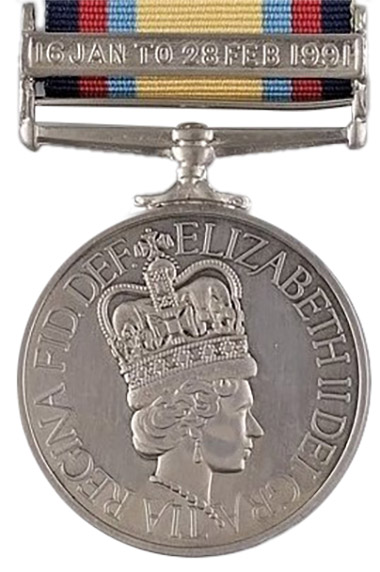
Gulf War Medal
The Gulf War Medal was a campaign medal approved in 1992, for issue to officers and men of British forces who served in Kuwait and Saudi Arabia during Operation Granby (the Liberation of Kuwait) in 1990–91.

Read a personal account of Gulf War One
 Date: 20 Jan 21
A Gulf Story (Part 1)
30 years ago on January 20th 1991 the driver and navigator of an aeroplane that was rented to them good working order was returned… Date: 21 Jan 21
A Gulf Story (Part 2)
Armourers are the guys who fit the bombs to the jets, in peacetime the jets often come back with bombs still fitted and the… Date: 23 Jan 21
A Gulf Story (Part 3)
Before I continue with the story itself, I also ought to explain a little bit more about the organisation of RAF fast jet operations.… Date: 30 Jan 21
A Gulf Story (Part 4)
I’m going to try to steer myself back to the original story about a damaged jet today, I’ve described some of the players in… Date: 31 Jan 21
A Gulf Story (Part 5)
On January 20th 1991, the air war had been going for 3 days, we as the Tornado force at Dhahran had already lost a… Date: 31 Jan 21
A Gulf Story (Part 6)
In the very early hours of January 20th 1991, I’m ‘off’ shift, in the hotel, more than likely not sleeping due to constant air… Date: 31 Jan 21
A Gulf Story (Part 7)
I’m not going to go into too many details of the mission itself, but ‘Dhahran Annie’ her crew, Colin and Chris and other crews… Date: 31 Jan 21
A Gulf Story (Part 8, The Penultimate)
The war in the Gulf and our involvement from Dhahran went on until February 27th, a few days after Dhahran Annie returned with its… Date: 02 Feb 21
A Gulf Story (Part 9, Conclusion)
We left Dhahran for the return to Bruggen in mid March, the days had started to drag, we’d seen off the jet’s, this time…


Research
Below are links of websites used to research this Operation / aircraft.
Have we got it wrong or want to add info?
Do you want to add more information or correct an error on this page then please use the form to send the information to the 31 Sqn Association.
I have an amendment